World State social stability
Brave New WorldWorld State social stability is the principle that organizes the society’s institutions and its account of human happiness. It joins the mass production of people to predetermined work, repeated lessons to accepted social norms, and managed pleasure to a continuously functioning economy. Its central paradox is that a population described as stable and content has been arranged so that neither its social position nor its desires can meaningfully change.
Production and Predestination
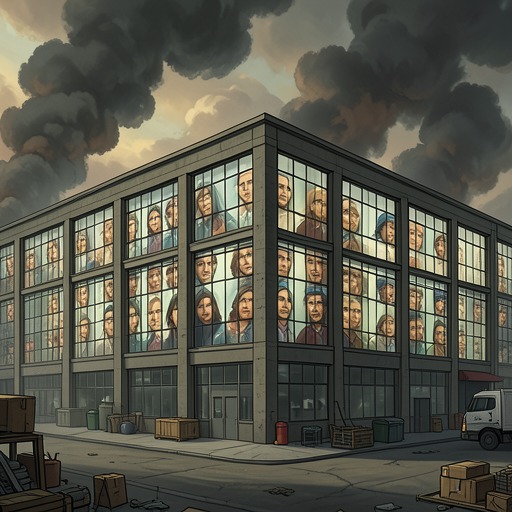
In the Hatchery, the Director identifies the Bokanovsky’s Process as a major instrument of social stability. It produces standard people in uniform batches: a single divided egg can supply the workers for a small factory, and the Director imagines ninety-six identical twins operating ninety-six identical machines. The comparison to mass production makes the governing purpose plain. Biological sameness is not merely an efficiency; it is a foundation for organizing society around predictable groups and tasks. The Director acknowledges a limit: the process cannot be applied indefinitely.
That industrial logic continues from the bottles into the administration of future lives. In the Social Predestination Room, labels transfer heredity, fertilization dates, and group membership from test-tube to bottle. An extensive card index is updated daily and coordinated with calculations of how many people of particular qualities should be produced and distributed. Predestinators send their figures to the Fertilizers, who provide the requested embryos; the resulting bottles are then predestined in detail. Individual existence is thus made legible to a system that plans population and labor together, including prompt replacement for unforeseen wastage.
Conditioning completes what production begins. In the tunnels, alternating heat and coolness, with hard X-rays accompanying the cold, gives embryos destined for tropical labor a physical aversion to cold. Later instruction is expected to make their minds endorse the bodily preference. The Director calls happiness and virtue a matter of liking what one has to do: conditioning is meant to make people like an inescapable social destiny. Stability therefore rests not only on assigning work, but on preparing workers to experience that assignment as suitable and desirable.
Lessons, Norms, and Consent
The same principle is implanted through sleep-teaching. A recorded lesson contrasts the castes’ clothing and abilities, teaching children to regard their own rank favorably and other groups with disdain. The lesson’s repeated judgments turn a hierarchy into a child’s ordinary understanding of the world. The Director describes suggestions as accumulating like drops of sealing wax until they become the child’s mind, then the adult’s mind: what people judge, desire, and decide is made up of messages supplied by the State.
Repetition also makes social rules seem self-evident rather than imposed. The Controller cites the hypnopaedic proverb that everyone belongs to everyone else, and the students accept it after more than sixty-two thousand repetitions in the dark. The lesson supports a norm against exclusive attachment. When Lenina says she has been seeing Henry for about four months and resists the suggestion that she should see other men, Fanny warns that such a prolonged attachment is bad form and invokes the Director’s objection to anything intense or long-drawn. Lenina eventually repeats the shared-belonging rule and agrees to make the effort. The episode shows a private preference being corrected through peer counsel and a slogan already lodged in common sense.
Consumption, too, is taught as a social reflex. In the nurseries, children hear that they love flying and new clothes; another lesson teaches that old clothes are beastly and that ending is better than mending. The words connect pleasure to buying and disposal, directing future demand toward industrial supply. The Controller describes the conscription of consumption as a means of rule: government works through habits and preferences, not simply force. A stable social order is reproduced when people experience economically useful behavior as what they naturally want.
Stability as an Economic and Emotional System
The Controller presents stability as a practical answer to the consequences of interruption. The machine must keep turning; if it stops, he says, the population will again face mass starvation. The wheels require attendants who are steady, obedient, and content. Grief, passion, illness, poverty, and old age are invoked as conditions that could make people unable to maintain the system. Stability is accordingly treated as both an economic necessity and a reason to prevent disruptive emotional experience.
The Controller’s image of water under pressure explains the policy’s emotional logic: when impulse is released through many small outlets, it produces scattered, manageable effects; when it is held back, feeling can accumulate into passion or madness. In the World State, desire is meant to move smoothly toward its expected satisfaction. An embryo receives a continuous blood-surrogate supply, and a crying infant is promptly given a bottle; the interval between desire and gratification is shortened so that intense feeling has fewer opportunities to form. The Controller describes the result as lives made emotionally easy and, as far as possible, protected from emotion itself.
Routine pleasure supports this arrangement. After taking soma, Lenina and Henry dine and go to a cabaret where mass entertainment and a sensory music performance occupy the evening. Their leisure is not outside the system of stability: it is among the managed satisfactions that keep life comfortable and predictable. At the same time, the Controller explains that even shorter working hours might not make lower-caste workers happier. An experiment that gave Ireland a four-hour day produced unrest and increased soma consumption; the added leisure did not become contentment. The state also keeps a third of the population in agriculture, although food could be synthesized, because producing food from land takes longer. In both cases, economic choices are justified as protections against destabilizing change, including excessive leisure and technological efficiency.
Costs and Contradictions
In his discussion with John, Mustapha Mond describes the advantages and exclusions built into the stable order. People get what they want and do not want what they cannot get; they are safe, spared illness and fear of death, and conditioned to behave as expected. Family ties and passionate attachments have little place in this account, while soma is available if anything goes wrong. Mond argues that stability requires choosing happiness over high art: the society has the feelies and scent organ rather than tragedy. The argument makes its trade-off explicit. Art that gives form to conflict and suffering is incompatible with a system designed to keep its members content.
The caste system is defended on similar grounds. Mond argues that a society made entirely of Alphas would be unstable and miserable: people capable of making choices and assuming responsibility would not accept Epsilon labor. Each caste must be conditioned for work that its members can endure without experiencing it as a sacrifice. Their apparent fitness for their place is therefore produced by the limits placed on their development, not evidence that the hierarchy is freely chosen.
Knowledge is also constrained in the name of keeping the system intact. Mond says that every change threatens stability and that even science must be treated as a possible enemy. The Nine Years’ War marks a turn toward controlling scientific research: after the destruction of war, people accepted control of their appetites in exchange for a quiet life. Research is restricted to immediate problems, while other inquiries are discouraged. Mond recounts that he himself once had to choose between exile, where he could pursue pure science, and a place on the Controllers’ Council; he chose service to the state, though he sometimes regrets abandoning science. His history gives the policy a personal dimension without undoing its force: the authority maintaining stability has itself made a sacrifice to it.
Social Meaning
The World State’s stability is neither a mere slogan nor a condition maintained only by overt command. It is assembled through the coordinated procedures of reproduction, data collection, caste assignment, physical conditioning, sleep-teaching, consumption, work, leisure, and restrictions on knowledge. Each stage narrows uncertainty: populations are calculated, tasks allocated, preferences rehearsed, and difficult feelings met with ready satisfaction. The result is a society that can describe its members as happy precisely because it has worked to limit what they are able to want or become.
The novel’s repeated contrast is between an order that avoids suffering and the human possibilities it excludes. The Controller acknowledges that high art and unrestricted science have been sacrificed for stability, while his own defense of the system ties comfort to predictable production and behavior. The promise of universal contentment thus carries an implicit cost: individuality, emotional depth, cultural inquiry, and the capacity to choose an unwelcome life are treated as risks to be managed rather than goods worth protecting.